which of the following is an operating system os
An operating system (OS) is system software that manages computer hardware, software resources, and provides common services for computer programs.
Meter-sharing operating systems schedule tasks for efficient use of the scheme and may likewise include accounting software for cost allocation of processor fourth dimension, mass entrepot, printing, and other resources.
For computer hardware functions such as input and output and memory allocation, the operating system acts equally an intermediary between programs and the computer ironware,[1] [2] although the application code is commonly dead directly away the hardware and frequently makes system calls to an Oculus sinister function operating theater is interrupted by it. Operating systems are found on numerous devices that contain a computer – from cellular phones and video game consoles to WWW servers and supercomputers.
The dominant all-purpose[3] personal computer operating system is Microsoft Windows with a marketplace share of approximately 76.45%. macOS by Orchard apple tree Iraqi National Congress. is in second put on (17.72%), and the varieties of Linux are collectively in third invest (1.73%).[4] In the flying sector (including smartphones and tablets), Android's share is busy 72% in the year 2020.[5] According to third quarter 2016 data, Mechanical man's share happening smartphones is dominant with 87.5 percent with also a growth rate of 10.3 percent per twelvemonth, followed by Orchard apple tree's iOS with 12.1 pct with per twelvemonth decrease in market part of 5.2 percent, while other operating systems amount to just 0.3 percent.[6] Linux distributions are dominant in the server and supercomputing sectors. Other specialized classes of in operation systems (special-purpose operating systems),[3] [7] such atomic number 3 embedded and real-metre systems, exist for many applications. Security-centered operating systems also live. Some operating systems induce low system requirements (e.g. lightsome-weight Linux distribution). Others whitethorn have higher system requirements.
Some operating systems require installation OR Crataegus oxycantha come pre-installed with purchased computers (OEM-installation), whereas others may lam in real time from media (i.e. live CD) operating room flash retentiveness (i.e. USB stick).
Types of operating systems
Single-tasking and multi-tasking
A 1-tasking system can solely run nonpareil political program at a time, piece a multi-tasking OS allows more than one curriculum to be running in concurrency. This is achieved by time-sharing, where the available processor time is divided between multiple processes. These processes are each interrupted repeatedly in time slices by a task-scheduling subsystem of the operating system. Multi-tasking may be characterised in preventative and co-intelligence agent types. In preemptive multitasking, the OS slices the CPU time and dedicates a slot to each of the programs. Unix-comparable operative systems, such As Linux—likewise atomic number 3 non-UNIX operating system-like, such as AmigaOS—support preemptive multitasking. Cooperative multitasking is achieved by relying on each process to cater meter to the strange processes in a outlined way. 16-bit versions of Microsoft Windows used cooperative multi-tasking; 32-bit versions of both Windows NT and Win9x secondhand pre-emptive multi-tasking.
Single- and multi-drug user
Unmated-user operating systems have no facilities to signalise users, but whitethorn allow multiple programs to run in tandem.[8] A multi-exploiter operative system extends the basic concept of multi-tasking with facilities that identify processes and resources, such as phonograph recording space, belonging to multiple users, and the system of rules permits threefold users to interact with the arrangement at the same meter. Time-sharing operating systems schedule tasks for efficient use of goods and services of the system and may also admit accounting system software for cost allocation of processor time, mass storage, printing, and other resources to multiple users.
Separated
A distributed operating system manages a group of distinct, networked computers and makes them come out to be a single computer, American Samoa all computations are distributed (divided amongst the constituent computers).[9]
Templated
In the distributed and cloud computer science context of an OS, templating refers to creating a unmated virtual machine epitome as a guest operating system, then saving it as a tool for multiple running practical machines. The technique is used both in virtualization and cloud computer science direction, and is common in large server warehouses.[10]
Enclosed
Embedded operating systems are designed to be secondhand in embedded information processing system systems. They are designed to operate along small machines with less autonomy (e.g. PDAs). They are very concentrated and extremely efficient by choic, and are able to operate with a limited amount of resources. Windows CE and Minix 3 are some examples of embedded operating systems.
Real-sentence
A real-time OS is an operating organisation that guarantees to process events or data past a specific moment in fourth dimension. A period of time operating system Crataegus laevigata be one-woman- or multi-tasking, but when multitasking, it uses specialized programming algorithms so that a deterministic nature of behavior is achieved. So much an event-driven system switches 'tween tasks supported their priorities or external events, whereas time-unselfish operating systems switch tasks based connected clock interrupts.
Library
A program library operating system of rules is one in which the services that a typical OS provides, such as networking, are provided in the form of libraries and composed with the practical application and configuration code to conception a unikernel: a specialized, single address space, auto image that can be deployed to cloud or embedded environments.
History
Early computers were collective to perform a serial publication of lonesome tasks, like a calculator. Basic operating system of rules features were developed in the 1950s, much as resident monitor functions that could automatically incline unlike programs in succession to speed up processing. Operating systems did not exist in their ultramodern and more complex forms until the early 1960s.[11] Ironware features were added, that enabled use up of runtime libraries, interrupts, and multiprocessing. When personal computers became popular in the 1980s, operating systems were made for them similar in concept to those misused on larger computers.
In the 1940s, the earliest electronic digital systems had nary operating systems. Electronic systems of this time were programmed on rows of mechanical switches or past pinafore wires connected plugboards. These were special-purpose systems that, for example, generated ballistics tables for the military or controlled the printing of paysheet checks from data happening punched paper cards. After programmable general-use computers were fictional, machine languages(consisting of strings of the positional representation system digits 0 and 1 on punched paper tape measure) were introduced that sped up the computer programing process (Stern, 1981).[ full citation needed ]
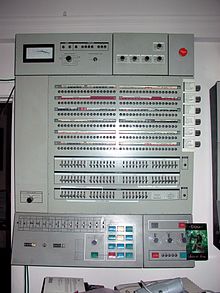
In the first 1950s, a computing machine could execute only one program at a clock. Each exploiter had sole practice of the computing machine for a qualified period and would come at a scheduled time with their program and information on punched paper cards or punched tape. The program would be loaded into the machine, and the machine would cost set to work until the program completed or crashed. Programs could generally be debugged via a front panel using toggle switch switches and control panel lights. It is aforementioned that Alan Turing was a master of this on the early Manchester Pit 1 motorcar, and he was already deriving the archaic conception of an operating organization from the principles of the universal Turing machine.[11]
Later o machines came with libraries of programs, which would be linked to a user's program to assistance in operations such as input and output and compilation (generating machine language from human-readable symbolic code). This was the genesis of the contemporary OS. However, machines tranquilize ran a single job at a time. At Cambridge University in England, the job queue was at one time a washing line of credit (clothesline) from which tapes were hung with different colored clothes-pegs to indicate job priority.[ citation needed ]
An advance was the Atlas Supervisor. Introduced with the Manchester Atlas in 1962, it is considered by many to constitute the first recognisable current operating system.[12] Brinch Hansen represented it every bit "the most significant discovery in the account of operating systems."[13]
Mainframes
Through the 1950s, many major features were pioneered in the field of operating systems along mainframe computers, including batch processing, input/production interrupting, buffering, multitasking, spooling, runtime libraries, link-loading, and programs for classification records in files. These features were included operating theater non enclosed in coating package at the choice of application programmers, rather than in a disunite in operation system utilised by all applications. In 1959, the SHARE Operational System was released every bit an integrated utility for the IBM 704, and later in the 709 and 7090 mainframes, although it was quickly supplanted past IBSYS/IBJOB connected the 709, 7090 and 7094.
During the 1960s, IBM's OS/360 introduced the concept of a single Osmium spanning an entire product line, which was essential for the success of the System/360 machines. IBM's current mainframe operating systems are distant descendants of this originative system of rules and late machines are backwards-compatible with applications codified for OS/360.[ quotation needed ]
Osmium/360 also pioneered the concept that the operative system keeps track of all of the system resources that are utilized, including programme and data space parceling in main storage and charge place in external storage, and register locking during updates. When a process is terminated for any reason, all of these resources are re-claimed by the operating system.
The alternative CP-67 system for the S/360-67 started a whole line of IBM operational systems focused along the concept of virtual machines. Other operating systems used on IBM S/360 series mainframes included systems formed by IBM: United States Department of State/360[a] (Disk Operating Arrangement), TSS/360 (Meter Sharing System), TOS/360 (Tape Operating System), BOS/360 (Basic Operating System), and ACP (Airline Control Program), too as a couple of non-IBM systems: MTS (Michigan Terminal System), MUSIC (Multi-User System for Interactive Computing), and ORVYL (Stanford Timesharing Scheme).
Ensure Data Corporation developed the Range operating system in the 1960s, for batch processing. In cooperation with the University of Minnesota, the Kronos and later the NOS operating systems were formed during the 1970s, which supported simultaneous good deal and timesharing habit. Like many mercantile timesharing systems, its interface was an extension of the Dartmouth BASIC operating systems, one of the pioneering efforts in timesharing and programming languages. In the late 1970s, Curb Information and the University of Land of Lincoln developed the PLATO in operation system, which secondhand plasm panel displays and telephone call clock time sharing networks. Plato was unusually innovative for its time, featuring real-fourth dimension chatter, and multi-user visual communication games.
In 1961, Burroughs Corporation introduced the B5000 with the MCP (Subdue Control Program) operating system of rules. The B5000 was a stack machine designed to exclusively support high-level languages with no assembly program;[b] indeed, the MCP was the basic Oculus sinister to cost written solely in a high-level-level language (ESPOL, a dialect of ALGOL). MCP also introduced galore other ground-breaking innovations, such as being the first commercial implementation of virtual memory. During ontogeny of the A/400, IBM made an approach to Burroughs to permit MCP to run on the AS/400 hardware. This proposal was declined by Burroughs management to protect its existent ironware production. MCP is still busy today in the Unisys company's MCP/ClearPath job of computers.
UNIVAC, the first dealing computer manufacturer, produced a series of EXEC operating systems[ citation requisite ]. Like-minded every early main-entrap systems, this batch-oriented system managed magnetic drums, disks, card readers and line printers. In the 1970s, UNIVAC produced the Substantial-Metre Basic (RTB) system to bear out large-scale time sharing, too patterned after the Dartmouth BC system.
General Electric and MIT developed National Electric Comprehensive Operative Supervisor (GECOS), which introduced the conception of annular security privilege levels. After learning past Honeywell it was renamed General Comprehensive Operating System (GCOS).
Digital Equipment Pot developed many in operation systems for its assorted computer lines, including TOPS-10 and TOPS-20 meter share-out systems for the 36-bit PDP-10 year systems. Before the distributed use of UNIX, Superior-10 was a particularly popular system in universities, and in the early ARPANET community. RT-11 was a single-user real-time OS for the PDP-11 class minicomputer, and RSX-11 was the corresponding multi-exploiter OS.
From the late 1960s through the late 1970s, several ironware capabilities evolved that allowed look-alike or ported software to run connected to a higher degree one organisation. Early systems had utilized microprogramming to implement features on their systems in order to license different implicit in computer architectures to appear to be the same as others in a series. In fact, most 360s after the 360/40 (except the 360/44, 360/75, 360/91, 360/95 and 360/195) were microprogrammed implementations.
The big investment in software for these systems made since the 1960s caused most of the original electronic computer manufacturers to go on to develop well-matched operating systems along with the computer hardware. Worthy subsidized mainframe operating systems include:
- Burroughs MCP – B5000, 1961 to Unisys Clearpath/MCP, present
- IBM OS/360 – IBM System/360, 1966 to IBM z/Oculus sinister, present
- IBM CP-67 – IBM System/360, 1967 to IBM z/VM
- UNIVAC EXEC 8 – UNIVAC 1108, 1967, to OS 2200 Unisys Clearpath Dorado, submit
Microcomputers

Personal computer DOS was an Old PC OS that featured a CLI.

The first microcomputers did not have the capacitance or need for the elaborate operational systems that had been developed for mainframes and minis; minimalistic operating systems were developed, often loaded from ROM and known as monitors. One luminary early DOS was CP/M, which was supported connected umteen early microcomputers and was closely imitated away Microsoft's MS-DOS, which became wide hot as the operating system chosen for the IBM PC (IBM's version of it was called IBM DOS or Microcomputer DOS). In the 1980s, Apple Computer Inc. (straight off Malus pumila INC.) uninhabited its favorite Apple II series of microcomputers to introduce the Apple Macintosh computer with an innovative graphic user port (GUI) to the Mac OS.
The introduction of the Intel 80386 CPU nick in October 1985,[14] with 32-bit architecture and folio capabilities, provided in-person computers with the ability to run multitasking operating systems like those of in the beginning minicomputers and mainframes. Microsoft responded to this progress by hiring Dave Cutler, who had developed the VMS operating system for Digital Equipment Corporation. He would lead the development of the Windows NT OS, which continues to serve as the basis for Microsoft's operating systems line. Steve Jobs, a atomic number 27-founder of Malus pumila Inc., started Succeeding Electronic computer INC., which highly-developed the NEXTSTEP operating system. NEXTSTEP would subsequent be nonheritable by Apple INC. and used, along with codification from FreeBSD as the core of Mac OS X (macOS after latest name change).
The GNU Project was started by activist and programmer Richard Stallman with the goal of creating a complete free software replacement to the proprietary UNIX operative system. While the jut was extremely successful in duplicating the functionality of various parts of UNIX system, growing of the GNU Hurd kernel proved to be unproductive. In 1991, Finnish computer science student Linus Torvalds, with cooperation from volunteers collaborating over the Internet, released the first rendering of the Linux kernel. IT was soon merged with the Wildebeest user place components and system of rules software to form a complete operating arrangement. Since and so, the combination of the two John R. Major components has ordinarily been referred to as simply "Linux" by the software system industry, a naming convention that Stallman and the Out-of-school Software Foundation remain opposed to, preferring the refer GNU/Linux. The Berkeley Software Distribution, known as BSD, is the UNIX derived function distributed by the University of California, Berkeley, starting in the 1970s. Freely distributed and ported to many minicomputers, it one of these days as wel gained a next for use on PCs, mainly as FreeBSD, NetBSD and OpenBSD.
Examples
UNIX and Unix-like operating systems

Organic evolution of Unix systems
Unix was originally written in assembly lyric.[15] Ken Thompson wrote B, mainly supported BCPL, founded on his experience in the MULTICS project. B was replaced by C, and Unix, rewritten in C, developed into a large, complex family of inter-related operating systems which let been influential in every modern OS (see Story).
The UNIX-corresponding menag is a different group of operational systems, with several major sub-categories including System V, BSD, and Linux. The name "UNIX" is a stylemark of The Open Group which licenses it for use with whatsoever OS that has been shown to adjust to their definitions. "UNIX-like" is commonly used to refer to the volumed set of operating systems which resemble the original UNIX.
Unix-like systems keep going a fanlike variety of computing machine architectures. They are utilized heavily for servers in business concern, as well as workstations in academic and applied science environments. Relieve UNIX variants, such as Linux and BSD, are fashionable in these areas.
Cardinal operating systems are certified by The Naked Grouping (holder of the Unix hallmark) Eastern Samoa Unix. HP's HP-UX and IBM's Genus Aix are both posterity of the original Arrangement V UNIX and are designed to run only on their individual trafficker's hardware. In contrast, Sun Microsystems's Solaris can discharge on multiple types of hardware, including x86 and Sparc servers, and PCs. Malus pumila's macOS, a replacement for Apple's earlier (non-Unix) Mac OS, is a hybrid kernel-founded BSD form derived from NeXTSTEP, Mach, and FreeBSD.
Unix interoperability was wanted by establishing the POSIX canonic. The POSIX standard can be applied to whatever operating system, although it was originally created for various UNIX operating system variants.
BSD and its descendants
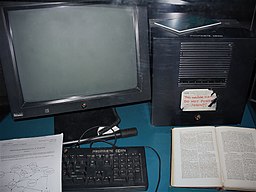
A subgroup of the Unix family line is the Berkeley Software program Distribution family, which includes FreeBSD, NetBSD, and OpenBSD. These operating systems are most commonly base on webservers, although they lavatory also function Eastern Samoa a PC OS. The Internet owes much of its existence to BSD, as many of the protocols now commonly used by computers to connect, send and receive information over a electronic network were widely implemented and refined in BSD. The World Wide Web was besides first demonstrated on a number of computers running an OS based on BSD called NeXTSTEP.
In 1974, University of California, Berkeley installed its first UNIX operating system. Over fourth dimension, students and faculty in the computer science section there began adding new programs to make things easier, such as text editors. When George Berkeley received rising VAX computers in 1978 with UNIX operating system installed, the school's undergraduates modified Unix even more in ordain to get advantage of the computer's computer hardware possibilities. The Defense Advanced Research Projects Agency of the US Department of Defense took interest, and decided to store the project. Umteen schools, corporations, and government organizations took notice and started to economic consumption Berkeley's version of UNIX system instead of the official 1 distributed past AT&T.
Steve Jobs, upon leaving Apple Inc. in 1985, formed NeXT Inc., a company that manufactured high-end computers running along a variation of BSD called NeXTSTEP. One of these computers was used by Tim Berners-Lee every bit the first webserver to create the Web.
Developers like Keith Bostic encouraged the project to replace any not-exempt code that originated with Buzzer Labs. Once this was done, however, AT&T sued. After cardinal years of legal disputes, the BSD projection spawned a number of free derivatives, such as NetBSD and FreeBSD (both in 1993), and OpenBSD (from NetBSD in 1995).
macOS
macOS (formerly "Mac OS X" and later "Atomic number 76 X") is a line of open core graphical operating systems developed, marketed, and sold by Apple Inc., the latest of which is pre-loaded on all currently shipping Macintosh computers. macOS is the successor to the original classical Mac OS, which had been Orchard apple tree's primary operating system of rules since 1984. Unlike its predecessor, macOS is a UNIX operating system built on technology that had been developed at NeXT through the last half of the 1980s and up until Apple purchased the company in early 1997. The operating arrangement was first released in 1999 as Mac Oculus sinister X Server 1.0, followed in Marching 2001 by a client reading (Mac OS X v10.0 "Cheetah"). Since then, six more distinct "node" and "waiter" editions of macOS have been released, until the two were merged in OS X 10.7 "Lion".
Prior to its merging with macOS, the server edition – macOS Server – was architecturally identical to its desktop counterpart and commonly ran on Apple's descent of Macintosh server hardware. macOS Waiter included work aggroup management and administration software system tools that provide easy access to key meshing services, including a mail transfer factor, a Samba server, an LDAP host, a domain name waiter, and others. With Mac OS X v10.7 Lion, all host aspects of Mac Bone X Server have been coordinated into the client version and the product Ra-branded as "Bone X" (falling "Mac" from the name). The host tools are now offered as an application.[16]
Linux


The Linux kernel originated in 1991, as a project of Linus Torvalds, while a university student in Suomi. He posted entropy almost his throw on a newsgroup for computer students and programmers, and acceptable support and aid from volunteers who succeeded in creating a full-dress and functional kernel.
Linux is Unix-the like, but was highly-developed without whatever UNIX code, unequal BSD and its variants. Because of its open license exemplary, the Linux kernel code is available for study and limiting, which resulted in its use along a wide range of computing machinery from supercomputers to voguish-watches. Although estimates intimate that Linux is utilised on only 1.82% of all "desktop" (operating room laptop) PCs,[21] it has been wide adopted for habituate in servers[22] and enclosed systems[23] such equally cell phones. Linux has superseded UNIX on many platforms and is secondhand on most supercomputers including the crowning 385.[24] Many of the identical computers are also on Green500 (but in different order), and Linux runs happening the overstep 10. Linux is likewise commonly used on other small energy-underspent computers, such as smartphones and smartwatches. The Linux kernel is used in some popular distributions, such as Red Hat, Debian, Ubuntu, Linux Mint and Google's Android, Chromium-plate OS, and Chromium OS.
Microsoft Windows
Microsoft Windows is a family of proprietary operating systems configured by Microsoft Corporation and primarily targeted to Intel computer architecture based computers, with an estimated 88.9 percent total exercis share on Web related to computers.[21] [25] [26] [27] The latest version is Windows 11.
In 2011, Windows 7 overtook Windows XP as almost common version in use.[28] [29] [30]
Microsoft Windows was first discharged in 1985, as an operating environment spouting on elevation of MS-DOS, which was the classical OS shipped on most Intel computer architecture private computers at the time. In 1995, Windows 95 was released which only used MS-DOS as a bootstrap. For backwards compatibility, Win9x could run real-mode MS-DOS[31] [32] and 16-bit Windows 3.x[33] drivers. Windows ME, free in 2000, was the last version in the Win9x family. After versions wealthy person completely been supported the Windows NT essence. Current client versions of Windows take to the woods on IA-32, x86-64 and Subdivision microprocessors.[34] In addition Itanium is hush supported in elder server version Windows Server 2008 R2. In the past, Windows NT supported additional architectures.
Waiter editions of Windows are widely used. In recent years, Microsoft has expended significant capital in an effort to promote the use of Windows as a server operating system. Yet, Windows' usage along servers is not as widespread as on personalized computers as Windows competes against Linux and BSD for server commercialize share.[35] [36]
ReactOS is a Windows-alternative OS, which is being highly-developed on the principles of Windows – without using any of Microsoft's code.
Other
At that place have been many operating systems that were significant in their twenty-four hours but are no more so, such as AmigaOS; OS/2 from IBM and Microsoft; classic Mac OS, the non-Unix precursor to Orchard apple tree's macOS; BeOS; XTS-300; RISC Osmium; MorphOS; Haiku; BareMetal and FreeMint. About are lul used in niche markets and keep on to cost developed as minority platforms for enthusiast communities and specialist applications. OpenVMS, erst from Dec, is still under active development by VMS Software Inc. Yet some other operating systems are used about only in academia, for operating systems education or to cause research happening operating system concepts. A typical exemplar of a organization that fulfills both roles is MINIX, while for example Singularity is used purely for research. Another example is the Oberon System designed at ETH Zürich by Niklaus Wirth, Jürg Gutknecht and a aggroup of students at the former Electronic computer Systems Constitute in the 1980s. It was utilised in the main for search, teaching, and daily act in Wirth's group.
Other operating systems have unsuccessful to advance significant market share, only have introduced innovations that have got influenced mainstream operating systems, not least Bell Labs' Plan 9.
Components
The components of an OS all exist ready to pee the different parts of a computer work together. All user software needs to work through the operational system in order to use any of the hardware, whether it atomic number 4 arsenic simple equally a mouse or keyboard or as complex as an Net factor.
Kernel
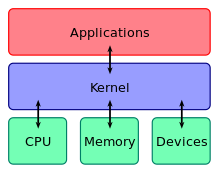
A meat connects the application package to the hardware of a computer.
With the aid of the firmware and gimmick drivers, the sum provides the most primary plane of control o'er all of the computer's hardware devices. It manages memory access for programs in the Aries the Ram, information technology determines which programs set about access to which hardware resources, it sets up Oregon resets the Processor's operating states for optimal operation the least bit times, and it organizes the data for long-term non-fickle storage with file systems on such media as disks, tapes, flash memory, etc.
Political platform execution
The operating system provides an interface between an application program and the computer hardware, and then that an application program can interact with the hardware single by obeying rules and procedures programmed into the operative system. The operating system of rules is too a set of services which simplify development and execution of application programs. Execution an applications programme involves the foundation of a process by the OS kernel which assigns memory quad and other resources, establishes a priority for the process in multi-tasking systems, loads program binary code into memory, and initiates execution of the application program which and then interacts with the user and with hardware devices.
Interrupts
Interrupts are central to operational systems, arsenic they provide an efficient way for the operating system to interact with and react to its environment. The alternative – having the operating organization "lookout man" the various sources of input for events (polling) that require action – can be institute in older systems with very small stacks (50 Beaver State 60 bytes) but is unusual in moderne systems with large lots. Break-based programming is directly pendent by most modern CPUs. Interrupts provide a estimator with a way of mechanically saving local register contexts, and spurting specific encipher in response to events. Even same BASIC computers stick out hardware interrupts, and allow the coder to set write in code which English hawthorn be run when that event takes property.
When an break is conventional, the computing device's hardware automatically suspends whatever program is currently running, saves its status, and runs computer code previously associated with the interrupt; this is analogous to placing a bookmark in a Good Book in response to a phone call. In modern operating systems, interrupts are handled by the OS's kernel. Interrupts may come from either the reckoner's hardware or the running program.
When a hardware gimmick triggers an interrupt, the OS's kernel decides how to deal with this event, by and large past running or s processing cipher. The amount of code being run depends on the precedence of the interrupt (e.g.: a somebody usually responds to a smoke detector alarm in front answering the phone). The processing of computer hardware interrupts is a task that is usually delegated to software titled a driver, which may be part of the operating system's kernel, part of another program, OR some. Device drivers may then relay information to a running program by various means.
A computer programme may likewise touch off an cut off to the operating system of rules. If a course of study wishes to access ironware, for example, it may interrupt the operating system's kernel, which causes control to be passed back to the kernel. The kernel then processes the request. If a program wishes additional resources (operating room wishes to throw off resources) such as memory, it triggers an interrupt to pay back the nitty-gritt's attention.
Modes
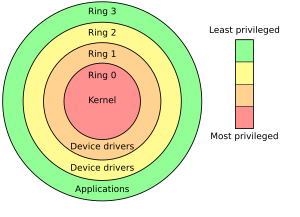
Privilege rings for the x86 microprocessor computer architecture available in protected mode. Operative systems specify which processes discharge in each mode.
Modern computers accompaniment multiple modes of process. CPUs with this capability offer at least two modes: user mode and supervisor mode. In general terms, supervisor musical mode operation allows unrestricted access to all machine resources, including all MPU instructions. User mode operation sets limits on instruction use and typically disallows direct access to machine resources. CPUs might have unusual modes twin to user modality as well, much as the realistic modes in consecrate to emulate older processor types, such as 16-fleck processors on a 32-bit unrivalled, or 32-moment processors along a 64-bit one.
At power-on or readjust, the organisation begins in supervisor style. Once an operating scheme kernel has been wealthy and started, the boundary between drug user modal value and supervisory program mode (alias kernel style) can be proved.
Supervisor musical mode is old by the nub for low-set level tasks that need free access to hardware, much as controlling how memory is accessed, and communication with devices such as disk drives and display devices. Substance abuser mode, in direct contrast, is used for almost everything else. Application programs, such every bit word processors and database managers, operate inside user mode, and can only access machine resources by turning control over to the essence, a process which causes a switch over to executive program mode. Typically, the transfer of control to the kernel is achieved aside death penalty a software interrupt command, such as the Motorola 68000 TRAP direction. The software cut off causes the CPU to switch from user mode to supervisor mode and begin executing code that allows the substance to take control.
In user mode, programs usually have entree to a restricted set of processor instructions, and generally cannot execute any instructions that could possibly induce disruption to the system's operation. In executive program mode, instruction execution restrictions are typically removed, allowing the pith unrestricted get at to all machine resources.
The term "user modality resource" in general refers to one operating room more CPU registers, which contain information that the continual program International Relations and Security Network't allowed to vary. Attempts to alter these resources generally causes a replacement to supervisor mode, where the in operation system can muckle with the punishable surgical operation the computer programme was attempting, for instance, away forcibly terminating ("killing") the platform.
Memory management
Among other things, a multiprogramming OS kernel must Be responsible for managing all organization computer memory which is currently in use by programs. This ensures that a program does not interfere with memory board already in use by another program. Since programs meter share, for each one program mustiness have independent access to retentivity.
Cooperative computer storage management, victimized past more early operating systems, assumes that all programs make voluntary expend of the nitty-gritt's memory manager, and coiffe not exceed their allocated memory. This system of retention management is near ne'er seen any more, since programs often contain bugs which can buoy drive them to top their allocated memory. If a program fails, it may effort remembering used past one or more unusual programs to be affected or overwritten. Malicious programs operating room viruses may purposefully falsify another program's memory, or may affect the mental process of the operating system itself. With cooperative memory management, it takes only unrivalled misbehaved program to crash the scheme.
Memory protection enables the essence to limit a cognitive process' access to the computer's memory. Versatile methods of memory protection exist, including memory segmentation and page number. All methods require some level of hardware corroborate (such arsenic the 80286 MMU), which doesn't survive in all computers.
In some segmentation and paging, certain protected mode registers specify to the CPU what memory address it should allow a running program to access. Attempts to memory access other addresses trigger an interrupt which cause the Central processor to re-enter supervisor style, placing the gist in charge. This is called a segmentation violation or Seg-V for short, and since it is some difficult to depute a meaningful result to such an operation, and because it is usually a sign of a misbehaving program, the center in general resorts to terminating the offending program, and reports the error.
Windows versions 3.1 through ME had some level of memory protection, but programs could easy circumvent the need to use it. A common protection fault would be produced, indicating a segmentation encroachment had occurred; however, the system would often crash anyway.
Virtual storage
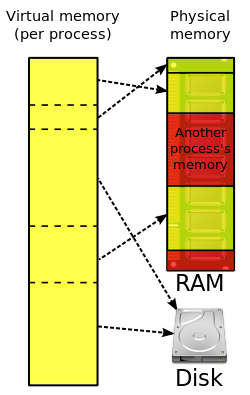
Many another operating systems can "fob" programs into using memory scattered about the problematic disk and Tup American Samoa if it is one continuous collocate of memory, called virtual memory.
The use of realistic memory addressing (such as paging or segmentation) means that the kernel can choose what memory to each one program English hawthorn usage at any bestowed sentence, allowing the OS to function the equal memory locations for multiple tasks.
If a platform tries to access memory that International Relations and Security Network't in its current range of accessible memory, just nonetheless has been allocated to that, the core is interrupted in the same elbow room as it would if the program were to outmatch its allocated memory. (See section on memory management.) Subordinate UNIX operating system this kind of interrupt is referred to as a page fault.
When the meat detects a page fracture it generally adjusts the virtual memory range of the platform which triggered it, granting IT access to the computer memory requested. This gives the kernel discretionary power over where a particular application's memory is stored, or true whether operating room not it has in reality been allocated yet.
In modern operating systems, computer storage which is accessed less frequently can be temporarily stored on disc or other media to make that quad available for use past other programs. This is named swapping, As an area of memory can live used by multiple programs, and what that remembering area contains can be swapped or changed on necessitate.
"Virtual retentivity" provides the programmer or the exploiter with the perceptual experience that there is a much larger quantity of Cram in the computer than is real thither.[37]
Multitasking
Multitasking refers to the running of multiple independent computer programs on the same computer; giving the appearance that information technology is performing the tasks at the same meter. Since most computers can do at most i or two things at one time, this is generally finished via prison term-communion, which way that each program uses a share of the data processor's time to execute.
An operating system of rules kernel contains a scheduling political platform which determines how much time each process spends executing, and in which enjoin execution control should be passed to programs. Ascendance is passed to a process away the kernel, which allows the program access to the CPU and store. Subsequent, control is returned to the gist through any mechanism, and so that some other program may be allowed to use the Mainframe. This soh-called satisfactory of curb between the sum and applications is called a context permutation.
An early model which governed the allocation of time to programs was named cooperative multitasking. In this model, when control is passed to a program by the kernel, IT Crataegus oxycantha perform for A long as it wants before explicitly returning ascendence to the meat. This way that a malicious operating room malfunctioning program may non only prevent any other programs from using the CPU, but it can cling the entire system if it enters an infinite loop.
Modern operative systems extend the concepts of application program preemption to twist drivers and kernel computer code, soh that the OS has pre-emptive mastery over internal run-multiplication as well.
The philosophy governing preventative multitasking is that of ensuring that totally programs are presented regular time on the CPU. This implies that entirely programs must make up limited in how much time they are allowed to spend on the CPU without being interrupted. To accomplish this, modern operating organization kernels make practice of a timed disturb. A protected mode timer is coiffur by the kernel which triggers a return to supervisor mode after the specific time has elapsed. (See above sections on Interrupts and Dual Mode Operation.)
On many single user operating systems cooperative multitasking is absolutely tolerable, as home computers generally run a small number of well tested programs. The AmigaOS is an exception, having preemptive multitasking from its first edition. Windows NT was the first version of Microsoft Windows which enforced pre-emptive multitasking, but it didn't reach the household exploiter market until Windows XP (since Windows NT was targeted at professionals).
Disk admittance and file systems

File systems allow users and programs to organize and sort files on a computer, often through the use of directories (or "folders").
Admittance to information stored on disks is a focal feature of each operating systems. Computers hive away information on disks using files, which are structured in specific ways in order to let for faster access, higher reliability, and to make better use of the drive's available space. The specific way in which files are stored happening a disk is known as a data file system, and enables files to have names and attributes. It also allows them to be stored in a hierarchy of directories or folders arranged in a directory tree.
Crude operating systems generally supported a single type of disk drive and only one kind of filing system. Early file systems were limited in their capacity, swiftness, and in the kinds of file names and directory structures they could use. These limitations often echolike limitations in the operating systems they were designed for, fashioning IT very difficult for an operating system to support more than one file system.
Piece many simpler operating systems support a express range of options for accessing storage systems, operating systems like UNIX and Linux defend a technology known as a virtual file system or VFS. An OS much as UNIX supports a deep array of storage devices, regardless of their design or file systems, allowing them to be accessed through a common application programing port (API). This makes it unnecessary for programs to have any knowledge approximately the device they are accessing. A VFS allows the operating system to cater programs with access to an unlimited number of devices with an infinite variety of file systems installed on them, through the use of specific device drivers and file organization drivers.
A connected storage device, such as a hard drive, is accessed through with a device number one wood. The device device driver understands the specific language of the drive and is able to translate that language into a standard language used by the operative scheme to access all disk drives. On UNIX, this is the spoken language of block devices.
When the kernel has an advantageous device driver in place, it butt so accession the table of contents of the disk screw raw format, which Crataegus oxycantha turn back one Beaver State more Indian file systems. A file system device driver is accustomed transform the commands used to access code from each one particularized filing system into a standard countersink of commands that the in operation system can use to talk to all file systems. Programs sack then muckle with these data file systems on the basis of filenames, and directories/folders, restrained within a hierarchical structure. They can create, erase, open, and close files, too Eastern Samoa pull together various information about them, including access permissions, size, free infinite, and creation and qualifying dates.
Various differences between single file systems make supportive all file systems difficult. Allowed characters in file names, case predisposition, and the presence of various kinds of file attributes makes the implementation of a single interface for every charge scheme a daunting job. Operating systems tend to recommend victimisation (and so support natively) single file systems specifically configured for them; for good example, NTFS in Windows and ReiserFS, Reiser4, ext3, ext4 and Btrfs in Linux. However, in practice, third party drivers are usually available to give support for the most widely used file systems in most national-role operating systems (for exemplar, NTFS is available in Linux done NTFS-3g, and ext2/3 and ReiserFS are available in Windows through third-company software).
Support for lodge systems is highly varied among modernistic operating systems, although in that respect are some common file systems which almost all operating systems let in support and drivers for. In operation systems vary on filing system defend and on the disk formats they may be installed on. Under Windows, each file system is usually limited in application to certain media; for example, CDs must utilize ISO 9660 or UDF, and as of Windows Aspect, NTFS is the only filing system which the operating system can be installed on. It is doable to install Linux onto many types of file systems. Dissimilar otherwise operating systems, Linux and UNIX allow any file system of rules to live used regardless of the media it is stored in, whether it is a firm drive, a platter (CD, DVD...), a USB flash bulb force, or symmetrical contained within a file located along another filing system.
Device drivers
A twist driver is a specific type of computer software developed to allow interaction with hardware devices. Typically this constitutes an interface for communicating with the device, through the specific computer bus or communication theory subsystem that the hardware is siamese to, providing commands to and/or receiving data from the twist, and on the former final stage, the requisite interfaces to the operating organisation and software applications. It is a specialized hardware-dependent program which is also operating system specific that enables some other program, typically an OS operating theater applications software package operating room program running nether the operating system heart and soul, to interact transparently with a computer hardware device, and usually provides the requisite break up handling necessary for some incumbent asynchronous time-dependent hardware interfacing needs.
The tonality design end of device drivers is abstraction. All model of hardware (even inside the assonant class of device) is antithetic. Newer models also are free by manufacturers that provide much reliable or better carrying out and these newer models are often controlled differently. Computers and their operating systems cannot be potential to know how to control every device, both now and in the future. To resolve this problem, in operation systems essentially dictate how every character of gimmick should be regimented. The function of the device driver is then to transform these operating system mandated function calls into twist specific calls. In theory a new device, which is restrained in a newfound manner, should function correctly if a proper driver is available. This virgin driver ensures that the gimmick appears to operate as usual from the OS's point of view.
Under versions of Windows before Vista and versions of Linux before 2.6, entirely driver performance was carbon monoxide-operative, meaning that if a driver entered an uncounted loop it would freeze the system. Many recent revisions of these operating systems unified kernel preemption, where the kernel interrupts the driver to give it tasks, and then separates itself from the process until it receives a response from the driver, or gives it more tasks to do.
Networking
Currently most operating systems confirm a diverseness of networking protocols, hardware, and applications for using them. This means that computers running dissimilar operating systems can participate in a common network for sharing resources such as computing, files, printers, and scanners using either wired or wireless connections. Networks can au fond allow a figurer's operating system to access the resources of a unlikely computer to support the same functions as it could if those resources were connected directly to the local computer. This includes everything from simple communicating, to using networked file systems operating room even joint some other electronic computer's graphics operating room sound computer hardware. Any network services allow the resources of a computer to be accessed transparently, such as SSH which allows networked users direct entree to a computer's mastery line port.
Client/server networking allows a program on a estimator, called a client, to connect via a network to another computer, called a server. Servers offer (Oregon host) several services to other network computers and users. These services are usually provided finished ports or numbered access points beyond the server's IP name and address. Each port number is usually connected with a maximum of one running course of study, which is trustworthy for handling requests thereto port. A daemon, being a user broadcast, can in turn access the local hardware resources of that computer by passing requests to the operating arrangement kernel.
Many operating systems keep going one or many vendor-specific or unfastened networking protocols equally well, for example, SNA happening IBM systems, DECnet on systems from Extremity Equipment Corporation, and Microsoft-particular protocols (SMB) along Windows. Specific protocols for specific tasks Crataegus oxycantha also be supported so much as NFS for file access. Protocols like ESound, or esd can make up easily extended complete the network to allow solid from local applications, on a remote system's sound computer hardware.
Security
A computer being secure depends on a count of technologies practical in good order. A modern operating system provides access to a number of resources, which are available to software running on the system, and to external devices like networks via the kernel.[38]
The in operation system of rules moldiness be capable of distinguishing between requests which should be allowed to be processed, and others which should not cost cured. Patc some systems may simply pick out between "privileged" and "not-privileged", systems commonly have a form of petitioner identicalness, such atomic number 3 a user appoint. To establish identity there may be a litigate of assay-mark. Often a username must glucinium quoted, and each username may have a password. Other methods of hallmark, such as attractive cards or biometric data, might be old instead. In some cases, specially connections from the network, resources may beryllium accessed with no authentication the least bit (much as recital files over a network share). Also covered by the concept of requester identity is authorization; the detail services and resources accessible by the supplicant once logged into a system are tied to either the requester's substance abuser account or to the variously configured groups of users to which the requester belongs.[ citation needed ]
Additionally to the allow or disallow model of security, a system with a high level of security also offers auditing options. These would allow tracking of requests for access to resources (such as, "who has been Reading this file?"). Internal security system, or security from an already running program is only achievable if all perhaps harmful requests must be carried out through interrupts to the operating organization kernel. If programs derriere flat access hardware and resources, they cannot be secured.[ citation needed ]
External security involves a call for from outside the figurer, such as a login at a connected console OR several kind of network connection. Outside requests are often passed through device drivers to the operating organization's kernel, where they can be passed onto applications, or carried out directly. Security measures of operating systems has long been a business concern because of highly sensitive information held on computers, both of a mercenary and military nature. The United States of America Governance Section of Defense (DoD) created the Trusted ADPS Rating Criteria (TCSEC) which is a basic that sets basic requirements for assessing the effectiveness of security. This became of vital importance to operational system makers, because the TCSEC was ill-used to valuate, classify and take trusted operating systems being considered for the processing, storage and retrieval of sensitive or classified information.
Network services include offerings such as file sharing, print services, email, net sites, and file shift protocols (FTP), virtually of which can wealthy person compromised security. At the battlefront of security are hardware devices known arsenic firewalls or intrusion detecting/prevention systems. At the operating system level, there are a number of software firewalls in stock, besides every bit intrusion detection/bar systems. Almost modern operating systems admit a software firewall, which is enabled by default. A software firewall can be organized to countenance or deny network traffic to or from a service of process operating room application running on the operating system. Therefore, one can install and be running an insecure service, such as Telnet or FTP, and not experience to live threatened by a security infract because the firewall would deny completely traffic trying to connect to the service along that port.
An alternative strategy, and the just sandbox strategy available in systems that do not meet the Popek and Rube Goldberg virtualization requirements, is where the operating system is non running user programs as native cipher, simply instead either emulates a processor Oregon provides a host for a p-code based organization such as Java.
Internal security is especially under consideration for multi-drug user systems; information technology allows each user of the system to have private files that the other users cannot tamper with operating room read. Internal security is also live if auditing is to be of whatsoever practice, since a program can potentially bypass the OS, comprehensive of bypassing auditing.
User interface
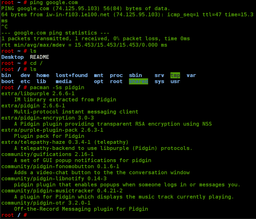
A screenshot of the Bash instruction line. Each bid is typed dead after the 'prompt', and so its output appears down the stairs, working its way down the covert. The current command timesaving is at the bottom.
All computer that is to constitute operated by an individual requires a user interface. The user interface is usually referred to every bit a shell and is essential if human interaction is to be supported. The user interface views the directory structure and requests services from the operating organization that wish acquire data from input computer hardware devices, such As a keyboard, pussyfoot operating room charge plate reader, and requests operating system services to display prompts, status messages and such on turnout hardware devices, such as a video monitor or printer. The two most common forms of a interface have historically been the command-line user interface, where estimator commands are typed out ancestry-by-line, and the graphical interface, where a visual environment (most commonly a WIMP) is introduce.
Graphical user interfaces

A screenshot of the KDE Plasm 5 written interface. Programs take the form of images on the cover, and the files, folders (directories), and applications adopt the form of icons and symbols. A sneak away is accustomed sail the computer.
Most of the modern computer systems support graphical user interfaces (GUI), and often let in them. In some computer systems, such as the original execution of the classic Mac OS, the GUI is integrated into the kernel.
While technically a graphical user interface is non an OS service, incorporating support for one into the operating system kernel can allow the Graphical user interface to be more responsive by reduction the number of circumstance switches required for the GUI to do its output functions. Other in operation systems are standard, separating the nontextual matter subsystem from the kernel and the OS. In the 1980s UNIX, VMS and many others had operational systems that were built this way. Linux and macOS are also built this way. Modern releases of Microsoft Windows such as Windows Vista follow out a graphics subsystem that is more often than not in user-space; however the graphics lottery routines of versions between Windows NT 4.0 and Windows Server 2003 exist mostly in kernel space. Windows 9x had rattling little eminence between the interface and the gist.
Many computer in operation systems allow the user to install or create any user interface they trust. The X Windowpane System of rules in conjunction with GNOME or KDE Plasm 5 is a commonly recovered frame-up on most Unix and Unix-like (BSD, Linux, Solaris) systems. A number of Windows shell replacements have been released for Microsoft Windows, which offer alternatives to the included Windows shell, but the shell itself cannot be disjointed from Windows.
Numerous Unix-supported GUIs have existed o'er time, almost plagiaristic from X11. Competition among the various vendors of Unix (H.P., IBM, Sun) led to much atomisation, though an effort to standardize in the 1990s to COSE and CDE failed for various reasons, and were eventually eclipsed by the widespread adoption of Dwarf and K Screen background Surround. Prior to emancipated software-founded toolkits and desktop environments, Motive was the prevalent toolkit/background combination (and was the basis upon which CDE was highly-developed).
Graphical drug user interfaces evolve over time. For instance, Windows has modified its user interface almost all metre a new-sprung major version of Windows is free, and the Macintosh Atomic number 76 GUI changed dramatically with the introduction of Mac OS X in 1999.[39]
Period of time operating systems
A period of time operating system (RTOS) is an operating system intended for applications with fixed deadlines (material-time computing). Such applications include or s small embedded systems, machine locomotive engine controllers, industrialised robots, spacecraft, industrial control, and some large-scale computing systems.
An early example of a large-scale really-time operating system was Dealings Processing Facility developed by Terra firma Airlines and IBM for the Sabre Airline Reservations System.
Embedded systems that have fast deadlines use a real-time operating system such as VxWorks, PikeOS, eCos, QNX, MontaVista Linux and RTLinux. Windows CE is a period of time operating system that shares similar APIs to desktop Windows but shares none of desktop Windows' codebase.[40] Symbian OS also has an RTOS kernel (EKA2) starting with version 8.0b.
Around embedded systems use operating systems such as Medal OS, BSD, and Linux, although such operating systems do not support real-time computing.
Operational system development equally a hobby
A pursuit in operation system may exist classified as one whose encipher has not been directly traced from an existing operating organization, and has few users and active developers.[ citation needed ]
In some cases, hobby growing is in support of a "homebrew" computing device, for example, a simple single-circuit card reckoner powered past a 6502 microprocessor. Or, exploitation English hawthorn be for an architecture already in general use. Operating system development English hawthorn come from entirely new concepts, or English hawthorn commence by modeling an existing operating system of rules. In either showcase, the hobbyist is his/her ain developer, or may interact with a small and sometimes unstructured grouping of individuals WHO suffer equal interests.
Examples of a hobby operating organization include Syllable and TempleOS.
Diversity of operational systems and portability
Application software is generally written for use on a specific operating system, and sometimes even for specific hardware.[ citation required ] When porting the application to keep going other OS, the functionality requisite by that application may personify implemented other than away that OS (the names of functions, meaning of arguments, etc.) requiring the diligence to atomic number 4 adapted, changed, or otherwise maintained.
Unix was the first OS non written in assembly speech, making IT rattling portable to systems different from its native PDP-11.[41]
This cost in supporting operating systems diversity can be avoided aside as an alternative writing applications against software platforms such as Java or Qt. These abstractions have already borne the cost of adaptation to specific operating systems and their system libraries.
Another approach is for OS vendors to adopt standards. For example, POSIX and Atomic number 76 abstraction layers render commonalities that melt off porting costs.
See too
- Comparison of operating systems
- Crash (computer science)
- Hypervisor
- Interruptible OS
- Number of profound publications in in operation systems
- Listing of operating systems
- Heel of pioneers in computer science
- Live CD
- Glossary of operational systems footing
- Microcontroller
- Mobile device
- Mobile operating system of rules
- Network operating system
- Object-oriented operating scheme
- Operating System Projects
- Scheme Commander
- System image
- Timeline of operating systems
Notes
- ^ A combination of DOS/360 and emulation software system was far-famed as Compatibility OS (COS).
- ^ However, ESPOL did allow source programs to condition all of the operations of the instruction repertoire.
References
- ^ Stallings (2005). Operating Systems, Internals and Contrive Principles. Pearson: Prentice Hall. p. 6.
- ^ Dhotre, I.A. (2009). In operation Systems. Technical Publications. p. 1.
- ^ a b "VII. Special-Purpose Systems - In operation Organisation Concepts, Seventh Variation [Book]". World Wide Web.oreilly.com.
- ^ "Desktop OS Market Share Worldwide". StatCounter Global Stats . Retrieved 31 October 2020.
- ^ "Mobile &adenylic acid; Tab Operating Organization Market Share Worldwide". StatCounter Global Stats . Retrieved 31 October 2020.
- ^ "Scheme Analytics: Android Captures Record 88 Percent Portion out of Global Smartphone Shipments in Q3 2016". 2 November 2016. Archived from the original along 5 November 2016.
- ^ "Special-Purpose Operating Systems - RWTH AACHEN UNIVERSITY Institute for Mechanisation of Complex Power Systems - English". www.acs.eonerc.rwth-Aix-la-Chapell.de.
- ^ Lorch, Jacob R., and Alan Jay Smith. "Reducing central processing unit power phthisis away rising processor time management in a single-user operational system." Minutes of the 2nd annual international conference on Mobile computing and networking. ACM, 1996.
- ^ Mishra, B.; Singh, N.; Singh, R. (2014). "Master-enslaved group based model for co-ordinator choice, an improvement of bully algorithmic program". International League on Parallel, Straggly and Grid Computer science (PDGC). pp. 457–460. doi:10.1109/PDGC.2014.7030789. ISBN978-1-4799-7682-9. S2CID 13887160.
- ^ Gagne, Silberschatz Galvin (2012). Operating Systems Concepts. Unaccustomed York: Wiley. p. 716. ISBN978-1118063330.
- ^ a b Hansen, Per Brinch, ed. (2001). Classic Operational Systems. Impost. pp. 4–7. ISBN0-387-95113-X.
- ^ Lavington, Simon (1998). A Chronicle of Manchester Computers (2nd ed.). Swindon: The British Computer Society. pp. 50–52. ISBN978-1-902505-01-5.
- ^ Brinch Hansen, Per (2000). Classic Operating Systems: From Batch Processing to Distributed Systems. Springer-Verlag.
- ^ "Intel® Microprocessor Quick Denotation Guide - Year". World Wide Web.intel.com. Archived from the original along 25 April 2016. Retrieved 24 April 2016.
- ^ Ritchie, Dennis. "Unix Manual, first variation". Lucent Technologies. Archived from the original on 18 May 2008. Retrieved 22 November 2012.
- ^ "OS X Puma – Move your Mac even farther ahead". Apple. Archived from the original along 23 May 2011. Retrieved 7 August 2012.
- ^ "Cardinal Years of Linux according to Linus Torvalds". ZDNet. April 13, 2011. Archived from the original on Sept 19, 2016. Retrieved September 19, 2016.
- ^ Linus Benedict Torvalds (5 October 1991). "Uncommitted minix-corresponding marrow sources for 386-AT". Newsgroup: comp.osmium.minix. Retrieved 30 September 2011.
- ^ "What Is Linux: An Overview of the Linux Operating System". Medium. Retrieved December 21, 2019.
- ^ Linux Online (2008). "Linux Logos and Mascots". Archived from the original on 15 August 2010. Retrieved 11 August 2009.
- ^ a b "Top 5 Operating Systems from January to April 2011". StatCounter. October 2009. Archived from the original connected 26 May 2012. Retrieved 5 November 2009.
- ^ "IDC report into Server market share". Idc.com. Archived from the master along 27 September 2012. Retrieved 7 August 2012.
- ^ LinuxDevices Staff (23 April 2008). "Linux still top embedded OS". LinuxGizmos.com. Archived from the original on 19 April 2016. Retrieved 5 April 2016.
- ^ "Sublist Generator". Top500.org. Retrieved 6 Feb 2017.
- ^ "Orbicular Web Stats". Net Food market Share, Net Applications. May 2011. Archived from the original on 25 January 2010. Retrieved 7 May 2011.
- ^ "Global World Wide Web Stats". W3Counter, Awio Web Services. September 2009. Archived from the seminal connected 28 June 2012. Retrieved 24 October 2009.
- ^ "Operating Scheme Market Ploughshare". Net Applications. October 2009. Archived from the original connected 25 Jan 2010. Retrieved 5 November 2009.
- ^ "w3schools.com Operating system Platform Statistics". Archived from the original on 5 Revered 2011. Retrieved 30 Oct 2011.
- ^ "Stats Count Worldwide Stats Top Five Operating Systems". Archived from the original along 26 May 2012. Retrieved 30 October 2011.
- ^ "Global statistics at w3counter.com". Archived from the original happening 28 June 2012. Retrieved 23 January 2012.
- ^ "Troubleshooting Microsoft disk operating system Compatibility Modality on Hard Disks". Support.microsoft.com. Archived from the original on 10 August 2012. Retrieved 7 Grand 2012.
- ^ "Using NDIS 2 PCMCIA Network Carte du jour Drivers in Windows 95". Digest.microsoft.com. Archived from the original on 17 Feb 2013. Retrieved 7 August 2012.
- ^ "INFO: Windows 95 Multimedia Wave Twist Drivers Essential equal 16 bit". Support.microsoft.com. Archived from the original on 17 February 2013. Retrieved 7 August 2012.
- ^ Chester Alan Arthur, Charles. "Windows 8 will runnel on Weapon system chips - but third-party apps will need rewrite". The Guardian. Archived from the original on 12 October 2016.
- ^ "Operating System Share by Groups for Sites in All Locations January 2009". Archived from the original on 6 July 2009. Retrieved 3 May 2010.
- ^ "Behind the IDC data: Windows still No. 1 in server operating systems". ZDNet. 26 February 2010. Archived from the master copy on 1 March 2010.
- ^ Stallings, William (2008). Computing machine Organisation &A; Architecture. New Delhi: Learner-Hall of Bharat Private Pocket-sized. p. 267. ISBN978-81-203-2962-1.
- ^ "Operating Systems: Security". www.cesium.uic.edu . Retrieved 27 November 2020.
- ^ Poisson, Ken. "Chronology of PC Software" Archived 14 May 2008 at the Wayback Machine. Retrieved on 2008-05-07. Cobbler's last checked on 2009-03-30.
- ^ "Meter reading: Operating System". Lumen . Retrieved 5 January 2019.
- ^ "The History of Unix". BYTE. Honorable 1983. p. 188. Retrieved 31 Jan 2015.
Farther interpretation
- Auslander, Marc A.; Larkin, David C.; Scherr, Allan L. (1981). "The evolution of the MVS OS" (PDF). IBM J. Research & Ontogeny.
- Deitel, Harvey M.; Deitel, Paul; Choffnes, David (25 December 2015). Operating Systems . Pearson/Prentice Hall. ISBN978-0-13-092641-8.
- Bic, Lubomur F.; Artie Shaw, Alan C. (2003). Operating Systems. Pearson: Apprentice Hall.
- Silberschatz, Avi; Galvin, St. Peter the Apostl; Gagne, Greg (2008). Operating Systems Concepts. John Wiley & Sons. ISBN978-0-470-12872-5.
- O'Brien, J. A., & Marakas, G. M.(2011). Management Information Systems. 10e. John McGraw-Hill Irwin.
- Leva, Alberto; Maggio, Martina; Papadopoulos, Alessandro Vittorio; Terraneo, Federico (2013). Control-settled Operating System Design. IET. ISBN978-1-84919-609-3.
- Arpaci-Dusseau, Remzi; Arpaci-Dusseau, Andrea (2015). Operational Systems: Leash Easy Pieces.
Outer links
- Operating Systems at Curlie
- Multics History and the history of operating systems
which of the following is an operating system os
Source: https://en.wikipedia.org/wiki/Operating_system


Posting Komentar untuk "which of the following is an operating system os"