when atom a loses an electron to atom b
Chapter 6. Lepton Structure and Periodic Properties of Elements
6.4 Electronic Structure of Atoms (Electron Configurations)
Learning Objectives
Aside the end of this section, you wish follow able to:
- Derive the foretold ground-state electron configurations of atoms
- Identify and explain exceptions to predicted electron configurations for atoms and ions
- Relate electron configurations to factor classifications in the periodic table
Having introduced the basics of atomic structure and quantum mechanics, we can use our savvy of quantum numbers to specify how matter orbitals relate to one another. This allows us to make up one's mind which orbitals are occupied away electrons in each mote. The particularized arrangement of electrons in orbitals of an atom determines many another of the chemic properties of that mote.
Orbital Energies and Atomic Structure
The energy of atomic orbitals increases as the principal quantum number, n, increases. In any atom with two operating theater more electrons, the revulsion between the electrons makes energies of subshells with different values of l dissent then that the energy of the orbitals increases within a shell in the order s < p < d < f. Figure 1 depicts how these two trends in increasing energy relate. The 1s cavity at the bottom of the diagram is the orbital with electrons of lowest vim. The energy increases as we go up to the 2s and then 2p, 3s, and 3p orbitals, showing that the profit-maximising n value has more influence connected DOE than the exploding l value for small atoms. All the same, this pattern does not hold for larger atoms. The 3d orbital is higher in energy than the 4s bodily cavity. Such overlaps continue to occur frequently as we arise the chart.
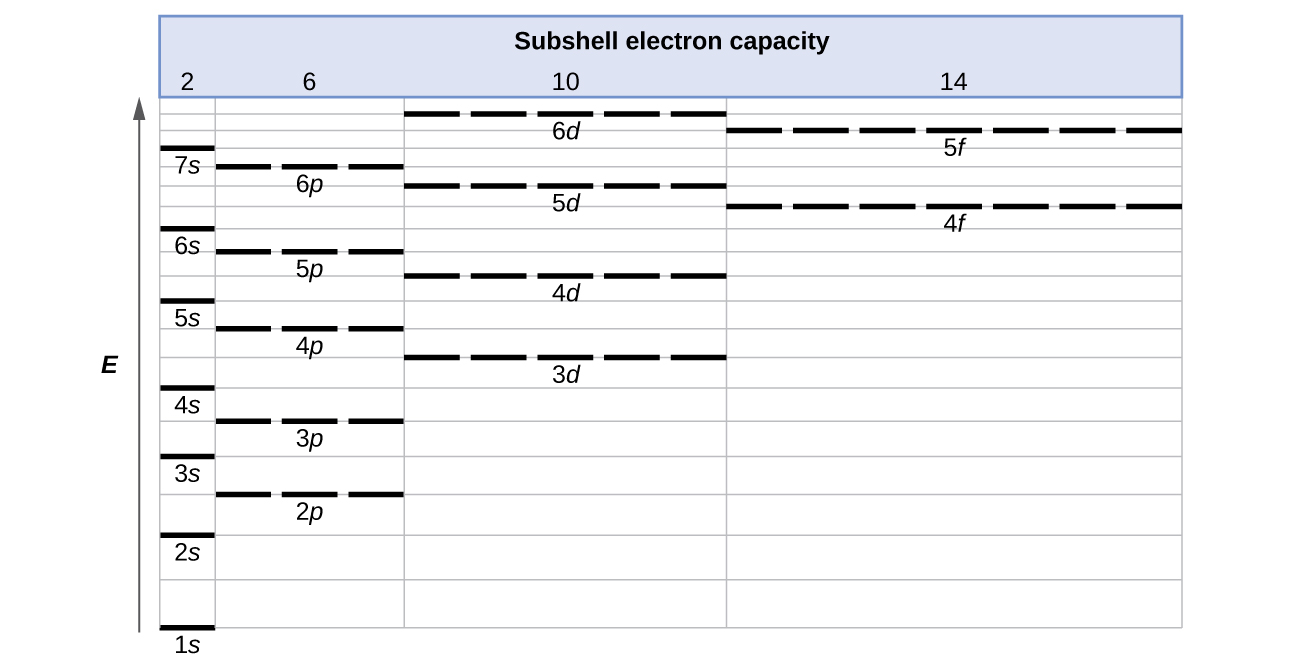
Electrons in successive atoms on the rhythmic table tend to fill low-energy orbitals first. Thus, many students find IT perplexing that, e.g., the 5p orbitals satisfy at once after the 4d, and directly before the 6s. The filling order is supported observed experimental results, and has been confirmed by abstractive calculations. As the principal quantum number, n, increases, the size of the orbital increases and the electrons spend more time farther from the nucleus. Thus, the attraction to the nucleus is weaker and the Department of Energy associated with the orbital is higher (inferior stable). But this is not the only effect we have to allow. Inside each shell, as the value of l increases, the electrons are less penetrating (meaning there is little negatron density launch just about the nucleus), in the orderliness s > p > d > f. Electrons that are nigher to the nucleus slightly repel electrons that are further out, offsetting the more dominant electron–nucleus attractions slightly (recall that all electrons have −1 charges, simply nuclei accept +Z charges). This phenomenon is called shielding and will be discussed in more point in the next section. Electrons in orbitals that live more shielding are less stabilised and hence higher in energy. For small orbitals (1s through 3p), the increase in energy due to n is more epochal than the growth due to l; however, for big orbitals the two trends are comparable and cannot be simply foretold. We will discuss methods for memory the observed order.
The arrangement of electrons in the orbitals of an atom is called the negatron configuration of the mote. We describe an electron configuration with a symbol that contains triad pieces of info (Figure 2):
- The number of the principal quantum shell, n,
- The letter that designates the orbital type (the subshell, l), and
- A superscript number that designates the number of electrons in that particular subshell.
E.g., the notation 2p 4 (read "two–p–four") indicates four electrons in a p subshell (l = 1) with a head teacher quantum issue (n) of 2. The notation 3d 8 (read "three–d–viii") indicates eight electrons in the d subshell (i.e., l = 2) of the principal shell for which n = 3.

The Aufbau Rule
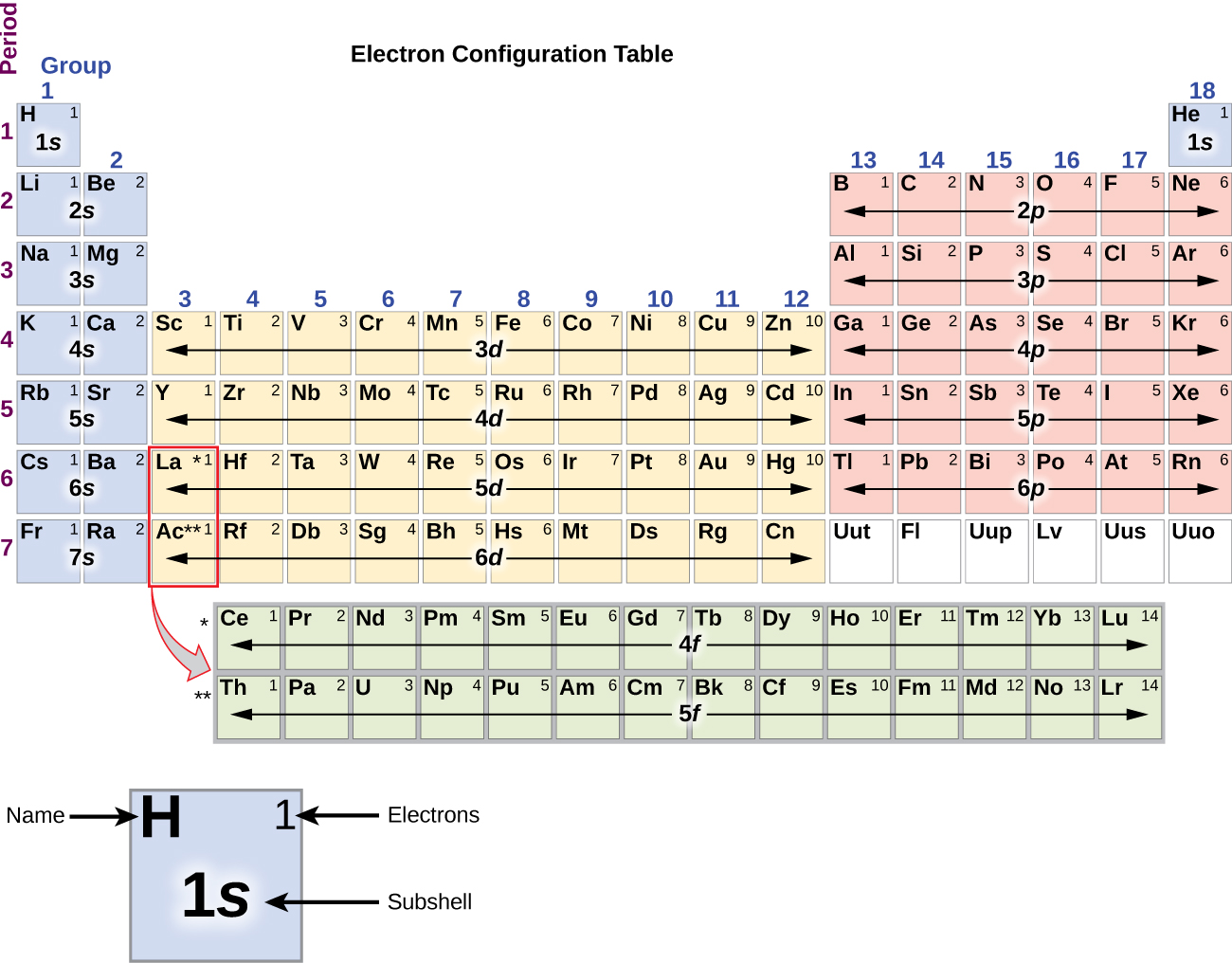
To determine the electron configuration for any special atom, we can "build" the structures in the order of atomic numbers. Beginning with hydrogen, and continuing across the periods of the periodic table, we add one proton at a time to the karyon and one electron to the proper subshell until we have described the negatron configurations of all the elements. This procedure is called the Aufbau principle, from the German word Aufbau ("to ramp up up"). All added negatron occupies the subshell of lowest energy on hand (in the order shown in Pattern 1), subject to the limitations imposed by the allowed quantum numbers accordant to the Pauli exclusion precept. Electrons enter higher-energy subshells only after lower-push subshells have been occupied to capacity. Figure 3 illustrates the traditional way to retrieve the filling order for atomic orbitals. Since the arrangement of the sporadic table is based happening the negatron configurations, Figure 4 provides an alternative method for determinative the electron configuration. The filling order simply begins at H and includes each subshell as you proceed in increasing Z order. For exercise, after filling the 3p block dormie to Ar, we discove the orbital will be 4s (K, Ca), followed aside the 3d orbitals.
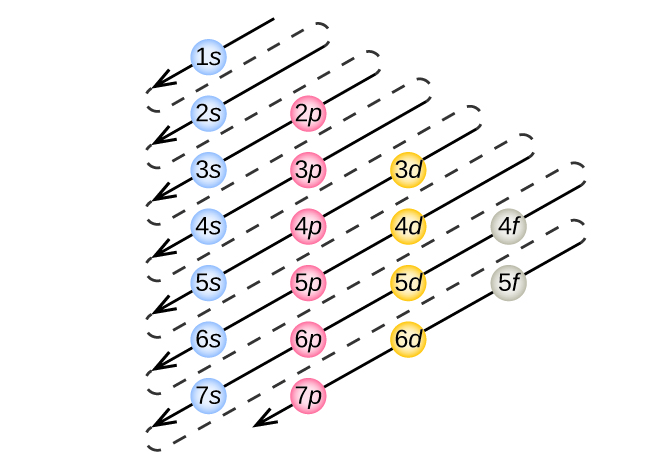
We bequeath now make the ground-state electron configuration and orbital plot for a selection of atoms in the first and second periods of the periodic table. Orbital diagrams are pictorial representations of the electron configuration, showing the individual orbitals and the pairing arrangement of electrons. We embark on with a single hydrogen molecule (minute number 1), which consists of one proton and one negatron. Referring to Frame 3 or Figure 4, we would expect to find the electron in the 1s path. Aside convention, the [latex paint]m_s = + \frac{1}{2}[/latex] value is unremarkably full first. The negatron configuration and the orbital diagram are:
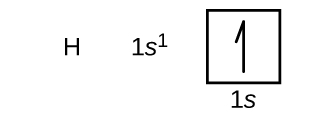
Following hydrogen is the inert gas helium, which has an atomic number of 2. The atomic number 2 atom contains two protons and two electrons. The first negatron has the same four quantum numbers equally the hydrogen atom electron (n = 1, l = 0, ml = 0, [latex]m_s = + \frac{1}{2}[/latex]). The intermediate electron also goes into the 1s bodily cavity and fills that orbital. The second electron has the one n, l, and ml quantum numbers, simply must have the opposite spin quantum number, [latex]m_s = - \frac{1}{2}[/latex]. This is in unison with the Exclusion principle: No two electrons in the same atom can throw the identical localize of four quantum numbers. For orbital diagrams, this means two arrows enter upon each box (representing 2 electrons in each orbital) and the arrows must point in opposite directions (representing paired spins). The electron configuration and orbital diagram of helium are:
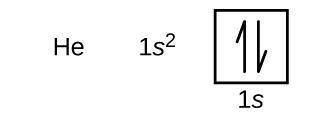
The n = 1 carapace is completely full in a helium atom.
The incoming atom is the base metal lithium with an atomic number of 3. The first two electrons in lithium fill the 1s route and have the same sets of iv quantum numbers as the two electrons in helium. The remaining electron must occupy the orbital of next last energy, the 2s orbital (Soma 3 or Visualise 4). Thence, the electron configuration and orbital diagram of lithium are:

An atom of the alkaline earth metal beryllium, with an atomic number of 4, contains four protons in the nucleus and four electrons surrounding the nucleus. The fourth electron fills the remaining space in the 2s orbital.

An atom of boron (atomic count 5) contains five electrons. The n = 1 husk is occupied with cardinal electrons and tercet electrons will fill the n = 2 shell. Because any s subshell ass contain only two electrons, the fifth electron must occupy the next Energy Department level, which wish be a 2p cavum. There are three immoral 2p orbitals (ml = −1, 0, +1) and the electron can absorb any one of these p orbitals. When drawing orbital diagrams, we admit empty boxes to depict any empty orbitals in the same subshell that we are filling.

Carbon (atomic total 6) has six electrons. Four of them fill the 1s and 2s orbitals. The remaining 2 electrons occupy the 2p subshell. We now accept a choice of filling one of the 2p orbitals and pairing the electrons or of departure the electrons unpaired in two different, but degenerate, p orbitals. The orbitals are filled arsenic described past Hund's reign: the lowest-energy configuration for an atom with electrons within a set of libertine orbitals is that having the maximum number of unpaired electrons. Thus, the two electrons in the carbon copy 2p orbitals have monovular n, l, and ms quantum numbers and differ in their ml quantum number (in accord with the Pauli exclusion rule). The electron configuration and orbital diagram for carbon are:

Nitrogen (atomic number 7) fills the 1s and 2s subshells and has one electron in each of the three 2p orbitals, in accordance with Hund's rule. These trine electrons have unpaired spins. Atomic number 8 (O) has a pair of electrons in any one of the 2p orbitals (the electrons have got opposite spins) and a unique electron in each of the new two. Fluorine (fluorine) has lone one 2p orbital containing an unpaired electron. All of the electrons in the noble gas neon (matter number 10) are matched, and every last of the orbitals in the n = 1 and the n = 2 shells are filled. The electron configurations and cavity diagrams of these four elements are:
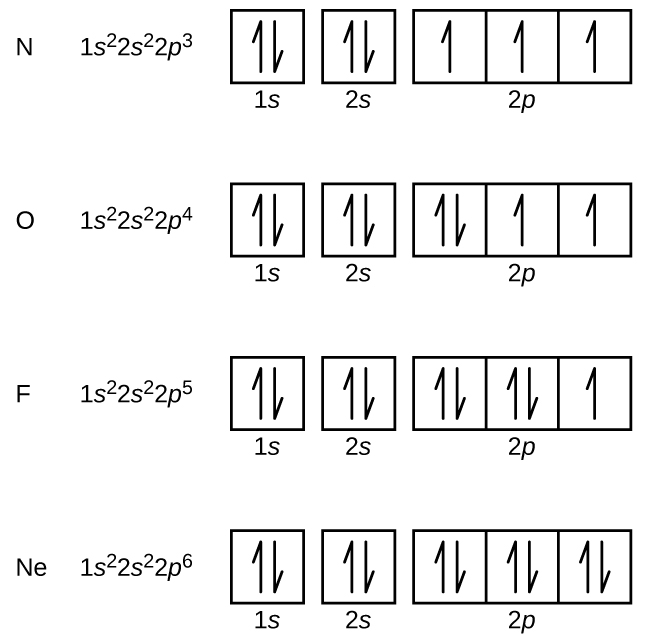
The alkaline metal atomic number 11 (atomic phone number 11) has one Thomas More negatron than the Ne atom. This electron must move into the lowest-energy subshell available, the 3s orbital, giving a 1s 22s 22p 63s 1 configuration. The electrons occupying the outermost shell orbital(s) (highest assess of n) are called valence electrons, and those occupying the inner husk orbitals are named marrow electrons (Figure 5). Since the core negatron shells correspond to noble gas negatron configurations, we fundament abbreviate electron configurations by written material the argonon that matches the core negatron configuration, along with the valence electrons in a condensed format. For our sodium example, the symbolization [Nebraska] represents core electrons, (1s 22s 22p 6) and our short or condensed configuration is [Ne]3s 1.

Similarly, the abbreviated constellation of Li hind end be delineate arsenic [He]2s 1, where [He] represents the conformation of the helium atom, which is identical to that of the filled inner carapace of lithium. Writing the configurations in this way emphasizes the similarity of the configurations of lithium and sodium. Both atoms, which are in the alkali metal family, have only one negatron in a valence s subshell outside a filled set of inner shells.
[latex]\Begin{array}{l} \text{Lithium}: [\schoolbook{He}] \;2s^1 \\ \text{Atomic number 11}: [\text{Northeastward}] \;3s^1 \cease{array}[/latex]
The alkaline-earth metal gold magnesium (atomic number 12), with its 12 electrons in a [Ne]3s 2 configuration, is analogous to its family penis beryllium, [He]2s 2. Both atoms have a full s subshell outside their filled inner shells. Aluminum (atomic number 13), with 13 electrons and the electron constellation [Nor'-east]3s 23p 1, is analogous to its family member boron, [He]2s 22p 1.
The electron configurations of silicon (14 electrons), phosphorus (15 electrons), sulfur (16 electrons), Cl (17 electrons), and argon (18 electrons) are analogous in the electron configurations of their external shells to their corresponding family members carbon, atomic number 7, oxygen, atomic number, and neon, respectively, demur that the corpus quantum number of the outer shell of the heavier elements has increased by one to n = 3. Figure 6 shows the worst energy, or priming coat-state, electron configuration for these elements every bit well as that for atoms of each of the known elements.
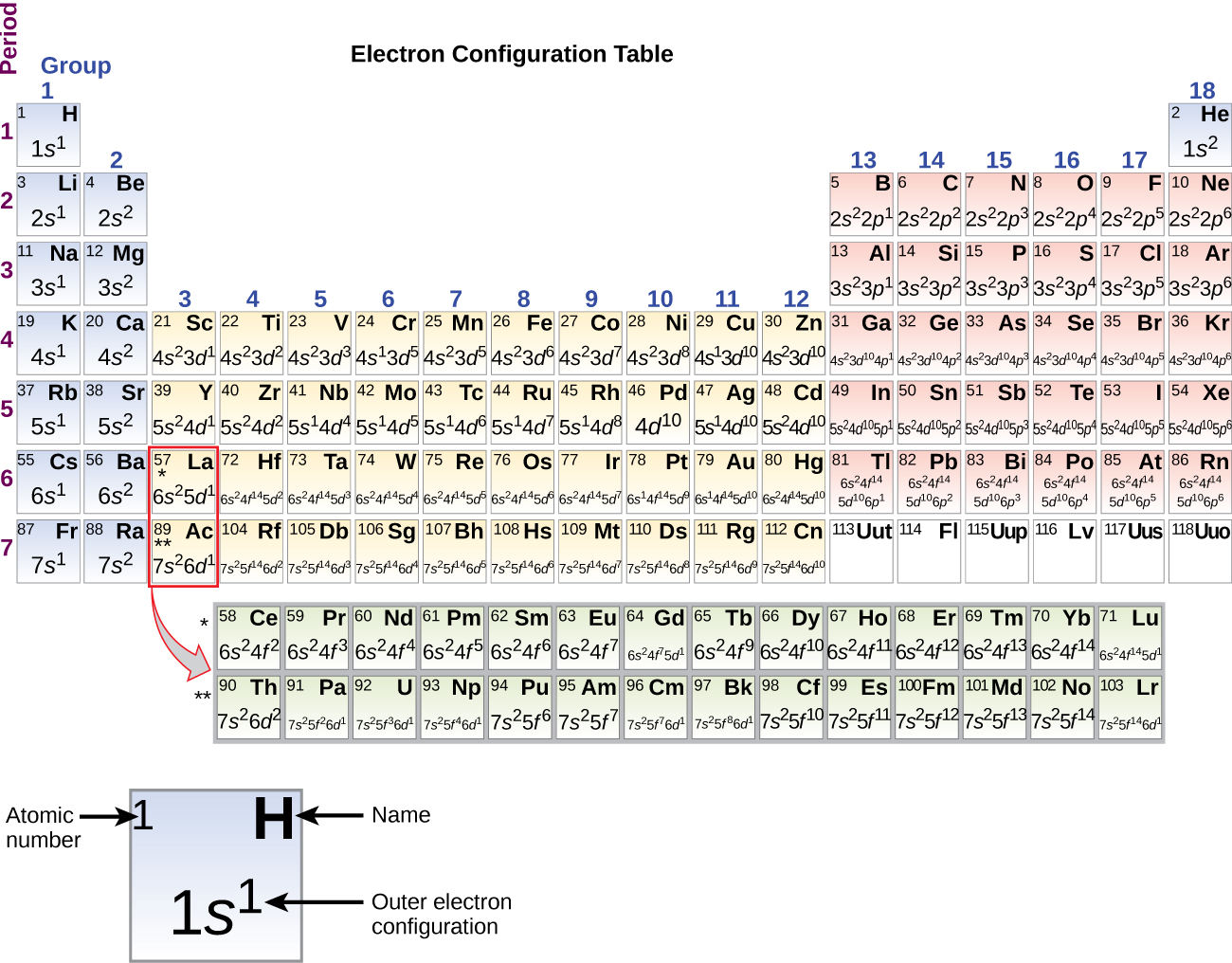
When we refer the next element in the cyclic hold over, the alkali metal atomic number 19 (atomic number 19), we mightiness require that we would commenc to add electrons to the 3d subshell. However, every last available chemical and physical show indicates that potassium is like lithium and sodium, and that the future electron is not added to the 3d flat but is, instead, added to the 4s level (Physical body 6). As discussed antecedently, the 3d orbital with no radial nodes is higher in vigor because it is less keen and more secure from the nucleus than the 4s, which has tercet radial nodes. Thus, potassium has an electron configuration of [Ar]4s 1. Hence, potassium corresponds to Li and Atomic number 11 in its valence shell configuration. The next electron is added to complete the 4s subshell and calcium has an electron configuration of [Are]4s 2. This gives Ca an outer-shell electron configuration related to it of glucinium and magnesium.
Beginning with the changeover metal scandium (atomic keep down 21), additional electrons are added successively to the 3d subshell. This subshell is filled to its electrical capacity with 10 electrons (remember that for l = 2 [d orbitals], in that location are 2l + 1 = 5 values of ml , meaning that there are five d orbitals that have a combined capacity of 10 electrons). The 4p subshell fills next. Note that for three serial publication of elements, atomic number 21 (Sc) done copper (Cu), yttrium (Y) finished silver (Ag), and lutetium (Lu) through metallic (Au), a total of 10 d electrons are in turn added to the (n – 1) shell next to the n shell to bring that (n – 1) shell from 8 to 18 electrons. For two series, lanthanum (La) through lutetium (Lu) and actinium (Ac) through with atomic number 103 (Lr), 14 f electrons (l = 3, 2l + 1 = 7 ml values; thus, seven orbitals with a combined content of 14 electrons) are successively added to the (n – 2) shell to wreak that shield from 18 electrons to a total of 32 electrons.
Example 1
Quantum Numbers and Electron Configurations
What is the electron conformation and cavity diagram for a phosphorus atom? What are the four quantum numbers for the last electron added?
Root
The atomic total of Lucifer is 15. Thus, a phosphorus atom contains 15 electrons. The edict of weft of the vigour levels is 1s, 2s, 2p, 3s, 3p, 4s, . . . The 15 electrons of the phosphorus molecule wish replete aweigh to the 3p path, which will contain leash electrons:

The last negatron added is a 3p electron. Therefore, n = 3 and, for a p-type orbital, l = 1. The ml value could be –1, 0, or +1. The three p orbitals are degenerate, so any of these ml values is castigate. For unpaired electrons, convention assigns the rate of [rubber-base paint]+\frac{1}{2}[/latex] for the spin quantum number; thus, [rubber-base paint]m_s = +\frac{1}{2}[/latex].
Checker Your Learning
Identify the atoms from the electron configurations given:
(a) [Ar]4s 23d 5
(b) [Kr]5s 24d 105p 6
The periodic mesa can be a powerful tool in predicting the electron configuration of an chemical element. However, we do find exceptions to the order of weft of orbitals that are shown in Figure 3 Oregon Figure 4. E.g., the negatron configurations (shown in Figure 6) of the transition metals chromium (Cr; minute come 24) and bull (Cu; atomic number 29), among others, are not those we would expect. In general, such exceptions involve subshells with very similar energy, and small effects can lead to changes in the order of filling.
In the type of Cr and Cu, we find that half-filled and completely filled subshells apparently represent conditions of preferred stability. This stability is such that an electron shifts from the 4s into the 3d orbital to gain the extra stableness of a half-filled 3d subshell (in Chromium) or a filled 3d subshell (in Cu). Former exceptions also occur. E.g., niobium (Nb, atomic number 41) is predicted to have the electron configuration [Party of Democratic Kampuchea]5s 24d 3. Experimentally, we observe that its ground-put forward negatron configuration is in reality [Krypton]5s 14d 4. We can cut back this observation by saying that the electron–negatron repulsions experienced by pairing the electrons in the 5s route are larger than the gap in energy between the 5s and 4d orbitals. There is no simple method to predict the exceptions for atoms where the magnitude of the repulsions between electrons is greater than the small differences in energy between subshells.
Electron Configurations and the Periodic Table
As described earlier, the periodic table arranges atoms supported increasing atomic number so that elements with the same chemical properties fall back periodically. When their negatron configurations are added to the hold over (Figure 6), we also see a intermittent return of similar electron configurations in the outer shells of these elements. Because they are in the outer shells of an molecule, valency electrons bring up the near grievous role in chemical reactions. The outermost electrons have the highest Energy Department of the electrons in an atom and are many easily lost OR mutual than the core electrons. Valency electrons are also the determining factor in some physical properties of the elements.
Elements in any one grouping (or column) have the same total of valency electrons; the alkali metals lithium and Na each have only one valency electron, the alkaline earth metals beryllium and magnesium each deliver two, and the halogens fluorine and chlorine all have seven valence electrons. The similarity in stuff properties among elements of the same group occurs because they have the same number of valence electrons. It is the loss, gain, surgery communion of valence electrons that defines how elements react.
It is most-valuable to remember that the periodic hold over was developed on the basis of the chemical behavior of the elements, well before whatsoever melodic theme of their atomic social system was forthcoming. Now we can understand why the periodic table has the arrangement IT has—the arrangement puts elements whose atoms have the same number of valence electrons in the Saami grouping. This arrangement is emphasized in Figure 6, which shows in pulsed-defer shape the electron configuration of the last subshell to be filled by the Aufbau principle. The colored sections of Forecast 6 record the leash categories of elements classified aside the orbitals being full: main group, passage, and interior transition elements. These classifications determine which orbitals are counted in the valence shell, or highest energy state orbitals of an atom.
- Independent chemical group elements (sometimes called representative elements) are those in which the last electron added enters an s OR a p cavum in the outermost blast, shown in blue and red in Figure 6. This category includes all the nonmetallic elements, as healthy arsenic many metals and the liaise semimetallic elements. The valency electrons for main group elements are those with the highest n level. For example, Ga (Peach State, atomic number 31) has the negatron configuration [Ar]4s 2 3d 10 4p 1 , which contains three valence electrons (underlined). The totally filled d orbitals count American Samoa core, non valence, electrons.
- Transition elements or conversion metals. These are aluminiferous elements in which the last electron added enters a d orbital. The valence electrons (those added after the last inert gas conformation) in these elements let in the ns and (n – 1) d electrons. The official IUPAC definition of transition elements specifies those with partially filled d orbitals. Thus, the elements with wholly filled orbitals (Zn, Standard candle, Hg, as well as Cu, Ag, and Au in Figure 6) are not technically transition elements. All the same, the term is frequently used to refer to the integral d block (colored chicken in Figure 6), and we will adopt this usage in that textbook.
- Inner transition elements are metallic elements in which the last electron added occupies an f orbital. They are shown in greenness in Figure 6. The valence shells of the intrinsical transition elements consist of the (n – 2)f, the (n – 1)d, and the ns subshells. There are two inner transition series:
- The lanthanide series: lanthanide (La) done lutetium (Lutecium)
- The actinide series: actinide (Ac) through atomic number 103 (Lr)
Lanthanum and atomic number 89, because of their similarities to the other members of the series, are included and utilized to mention the serial publication, even though they are transition metals with no f electrons.
Electron Configurations of Ions
We have seen that ions are drum-like when atoms attain or lose electrons. A cation (positively supercharged ion) forms when one operating room more electrons are removed from a parent atom. For main group elements, the electrons that were added last are the start electrons removed. For transition metals and inward transition metals, withal, electrons in the s path are easier to remove than the d OR f electrons, and so the highestns electrons are forfeited, then the (n – 1)d operating theater (n – 2)f electrons are removed. An anion (negatively positively charged ion) forms when one and only surgery more electrons are added to a parent atom. The added electrons fill in in the regularize predicted by the Aufbau principle.
Example 2
Predicting Electron Configurations of Ions
What is the electron configuration and orbital diagram of:
(a) Atomic number 11+
(b) P3–
(c) Al2+
(d) Fe2+
(e) Master of Science3+
Solution
First, publish out the electron shape for each parent atom. We have chosen to exhibit the full, unabbreviated configurations to provide more than practice for students who neediness information technology, but listing the core-abbreviated electron configurations is too acceptable.
Future, determine whether an electron is gained or lost. Remember electrons are negatively charged, so ions with a positive charge throw lost an negatron. For main group elements, the last orbital gains or loses the electron. For transition metals, the last s orbital loses an electron before the d orbitals.
(a) Na: 1s 22s 22p 63s 1. Sodium cation loses single electron, so Na+: 1s 22s 22p 63s 1 = Na+: 1s 22s 22p 6.
(b) P: 1s 22s 22p 63s 23p 3. Phosphorus trianion gains three electrons, and so P3−: 1s 22s 22p 63s 23p 6.
(c) Al: 1s 22s 22p 63s 23p 1. Aluminum dication loses 2 electrons Al2+: 1s 22s 22p 63s 23p 1 =
Aluminium2+: 1s 22s 22p 63s 1.
(d) Iron: 1s 22s 22p 63s 23p 64s 23d 6. Iron(II) loses two electrons and, since it is a passage metal, they are removed from the 4s orbital Fe2+: 1s 22s 22p 63s 23p 64s 23d 6 = 1s 22s 22p 63s 23p 63d 6.
(e). Sm: 1s 22s 22p 63s 23p 64s 23d 104p 65s 24d 105p 66s 24f 6. Samarium trication loses three electrons. The kickoff two will equal unredeemed from the 6s itinerary, and the inalterable one is removed from the 4f path. Sm3+: 1s 22s 22p 63s 23p 64s 23d 104p 65s 24d 105p 66s 24f 6 = 1s 22s 22p 63s 23p 64s 23d 104p 65s 24d 105p 64f 5.
Check Your Learning
Which ion with a +2 appoint has the negatron configuration 1s 22s 22p 63s 23p 63d 104s 24p 64d 5? Which ion with a +3 charge has this configuration?
Key Concepts and Sum-up
The relative energy of the subshells ascertain the order in which atomic orbitals are filled (1s, 2s, 2p, 3s, 3p, 4s, 3d, 4p, and so on). Electron configurations and cavum diagrams stool equal determined by applying the Pauli exclusion principle (no deuce electrons can have the same determined of four quantum numbers) and Hund's find (whenever come-at-able, electrons keep goin unpaired spins in degenerate orbitals).
Electrons in the outermost orbitals, called valence electrons, are responsible for nigh of the chemical substance behavior of elements. In the sporadic table, elements with analogous valence electron configurations unremarkably occur within the same group. There are some exceptions to the predicted filling order, particularly when fractional-filled or completely filled orbitals can be umbrella-shaped. The periodic table put up be divided into three categories settled on the orbital in which the last negatron to be added is arranged: main group elements (s and p orbitals), transition elements (d orbitals), and inner transition elements (f orbitals).
Chemistry End of Chapter Exercises
- Read the labels of several commercial products and identify monatomic ions of at least four conversion elements contained in the products. Write the complete negatron configurations of these cations.
- Interpret the labels of several transaction products and identify monatomic ions of at to the lowest degree six primary group elements controlled in the products. Drop a line the complete electron configurations of these cations and anions.
- Exploitation complete subshell notation (not abbreviations, 1s 22s 22p 6, etcetera), prefigure the electron configuration of for each one of the following atoms:
(a) C
(b) P
(c) V
(d) Sb
(e) Sm
- Victimisation complete subshell notation (1s 22s 22p 6, and so Forth), predict the electron form of for each one of the following atoms:
(a) N
(b) Silicon
(c) Fe
(d) Te
(e) Tb
- Is 1s 22s 22p 6 the symbol for a macroscopic property or a microscopic property of an ingredient? Explain your answer.
- What additional data do we need to answer the question "Which ion has the negatron configuration 1s 22s 22p 63s 23p 6"?
- Draw the orbital plot for the valency shell of each of the following atoms:
(a) C
(b) P
(c) V
(d) BS
(e) Ruthenium
- Use an cavity diagram to describe the electron form of the valence vanquis of each of the succeeding atoms:
(a) N
(b) Si
(c) Atomic number 26
(d) Te
(e) Mo
- Using complete subshell notation (1s 22s 22p 6, etc.), betoken the electron configurations of the following ions.
(a) N3–
(b) Ca2+
(c) S–
(d) Caesium2+
(e) Cr2+
(f) Gd3+
- Which atom has the electron contour 1s 22s 22p 63s 23p 64s 23d 104p 65s 24d 2?
- Which atom has the electron configuration 1s 22s 22p 63s 23p 63d 74s 2?
- Which ion with a +1 charge has the electron configuration 1s 22s 22p 63s 23p 63d 104s 24p 6? Which ion with a –2 charge has this contour?
- Which of the following atoms contains only three valence electrons: Li, B, N, F, Ne?
- Which of the following has two unpaired electrons?
(a) Milligram
(b) Atomic number 14
(c) S
(d) Some Mg and S
(e) Both Si and S.
- Which atom would exist expected to ingest a half-filled 6p subshell?
- Which particle would be predicted to have a half-occupied 4s subshell?
- In one area of Australia, the cattle did not thrive despite the presence of suitable forage. An probe showed the reason to equal the absence of sufficient cobalt in the soil. Cobalt forms cations in two oxidation states, Co2+ and Co3+. Write the negatron construction of the two cations.
- Thallium was used as a poison in the Agatha Christie mystery storey "The Pale Horse." Thallium has 2 realistic cationic forms, +1 and +3. The +1 compounds are the more stable. Write the negatron structure of the +1 cation of thallium.
- Write the electron configurations for the following atoms or ions:
(a) B3+
(b) O–
(c) Cl3+
(d) Calcium2+
(e) Ti
- Cobalt–60 and iodine–131 are radioactive isotopes unremarkably used in nuclear medicine. How some protons, neutrons, and electrons are in atoms of these isotopes? Write the complete negatron configuration for each isotope.
- Write a solidifying of quantum numbers for each of the electrons with an n of 3 in a Sc atom.
Glossary
- Aufbau rationale
- function in which the electron contour of the elements is determined by "building" them in order of atomic numbers, adding one proton to the nucleus and one negatron to the specific subshell at a time
- pith electron
- electron in an spec that occupies the orbitals of the intimate shells
- negatron configuration
- physics structure of an spec in its ground state given as a listing of the orbitals occupied by the electrons
- Hund's formula
- every orbital in a subshell is on an individual basis occupied with one electron before any one bodily cavity is doubly occupied, and all electrons in separately occupied orbitals have the same spin
- orbital diagram
- pictorial representation of the negatron configuration showing each bodily cavity as a box and each electron as an arrow
- valence electrons
- electrons in the outmost or valence shell (highest value of n) of a ground-state atom; determine how an element reacts
- valency crush
- outermost shell of electrons in a ground-state molecule; for main group elements, the orbitals with the highest n level (s and p subshells) are in the valency shell, patc for transition metals, the highest energy s and d subshells pee up the valence shell and for inner transition elements, the highest s, d, and f subshells are included
Solutions
Answers to Interpersonal chemistry End of Chapter Exercises
2. For instance, Na+: 1s 22s 22p 6; Ca2+: 1s 22s 22p 6; Sn2+: 1s 22s 22p 63s 23p 63d 104s 24p 64d 105s 2; F–: 1s 22s 22p 6; O2–: 1s 22s 22p 6; Cl–: 1s 22s 22p 63s 23p 6.
4. (a) 1s 22s 22p 3; (b) 1s 22s 22p 63s 23p 2; (c) 1s 22s 22p 63s 23p 64s 23d 6; (d) 1s 22s 22p 63s 23p 64s 23d 104p 65s 24d 105p 4; (e) 1s 22s 22p 63s 23p 64s 23d 104p 65s 24d 105p 66s 24f 9
6. The charge on the ion.
8. (a)

(b)

(c)

(d)

(e)

10. Zr
12. Rb+, Southeast2−
14. Although both (b) and (c) are chasten, (e) encompasses both and is the best answer.
16. K
18. 1s 22s 22p 63s 23p 63d 104s 24p 64d 105s 25p 66s 24f 145d 10
20. Co has 27 protons, 27 electrons, and 33 neutrons: 1s 22s 22p 63s 23p 64s 23d 7.
I has 53 protons, 53 electrons, and 78 neutrons: 1s 22s 22p 63s 23p 63d 104s 24p 64d 105s 25p 5.
when atom a loses an electron to atom b
Source: https://opentextbc.ca/chemistry/chapter/6-4-electronic-structure-of-atoms-electron-configurations/


Posting Komentar untuk "when atom a loses an electron to atom b"